Research Expertise
We have an extensive network of scientific institutions and universities. This collaboration gives us access to expert knowledge and ensures that our projects are practice-oriented. Our goal is to develop methods for producing artificial tissues that can be used in clinical settings.
Biofabrication & Engineering
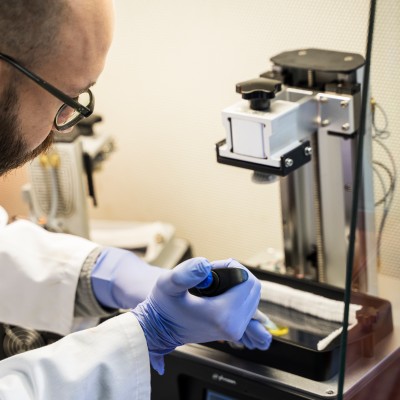
Bioprinting and Material Development:
Bioprinting encompasses 3D printing processes in which biomaterials and cells can be assembled into complex, tissue-like structures. Modern light-based bioprinting technologies make it possible to produce such structures with high spatial precision and to specifically control their properties. By varying the material composition and exposure parameters, mechanical and biochemical properties can be adjusted to influence cellular behavior—such as cell adhesion, migration, growth, and differentiation. This results in 3D models that more accurately mimic natural tissues and can be used for tumor research and to gain a better understanding of cellular processes. By using three-dimensional cell culture systems that integrate human cells, we create microenvironments that closely resemble natural conditions, in which cardiovascular and musculoskeletal tissue can mature under physiological conditions. Biomechanical stimulation and customized scaffolds promote the structural and functional organization of the cells. At the same time, novel dynamic perfusion devices are being developed that enable a controlled supply of nutrients, mechanical conditioning, and the examination of constructs over extended periods. These bioreactor systems simulate the mechanical forces found in native cellular environments and specifically accelerate tissue maturation. Our goal: functional models that allow for a more in-depth investigation of the function-structure relationships of various tissue structures.
Analysis & Testing
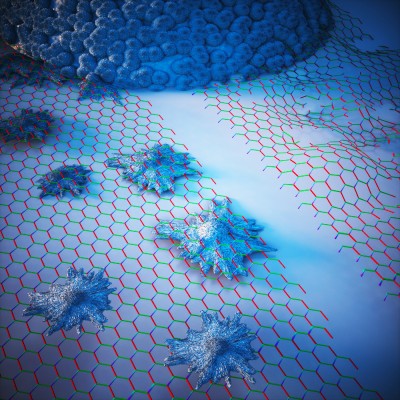
Mechanical Characterization - AFM and Microindentation:
Using atomic force microscopy (AFM), we quantify the nanomechanical properties of cartilage and vascular tissue at both, the single-cell level and within intact tissue assemblies. In addition, macroscopic indentation and compression testing systems enable the measurement of mechanical properties at the tissue level. The combination of both scales—from single-cell mechanics to macroscopic tissue response—enables a comprehensive biomechanical evaluation of native as well as in vitro-generated constructs. The correlation of these parameters with histological and biochemical analyses provides a complete picture of the structural and functional quality of the tissue. Thus, multiscale mechanical characterization provides essential evaluation criteria for the development of functional cartilage and vascular constructs in tissue engineering.
Laboratory equipment
01 Bioprinting
We hereby enable the fabrication of biological structures as well as the printing of cell-loaded hydrogels.
- mSLAb based (Various modifications)
- CellInk Bio X6
02 LIFT Setup
A collaboratively developed and shared setup with the Laser Center at Munich University of Applied Sciences
- Experimental setup/platform for laser-based cell transfer (single cells, spheroids)
03 Basic Cell Biology Equipment
The cell biology infrastructure enables the sterile cultivation, manipulation, and long-term observation of cells. It forms the basis for all work involving primary cells, cell lines, and 3D models.
- Safety cabinets
- Incubators
- Autoclaves
- Nucleofector electroporator
04 Laboratory equipment for cell and molecular biology analysis
A wide range of instruments is available for DNA, RNA, and protein analysis, enabling quantitative and qualitative assessments as well as evaluations of cell viability.
- LightCycler 480 qPCR system (Roche)
- Leica CM 1950 cryostat
- Centrifuges
- Tecan multiwell Plate Reader
- Gel electrophoresis chambers and documentation
05 Microscopy & Imaging
The microscopy division covers high-resolution imaging of live and fixed samples—from confocal fluorescence to nanoscale force measurement.
- Leica Stellaris 8 (CLSM) + Bruker AFM Nanowizard 4
- Zeiss Observer Z1 (epifluorescence) + Apotome + incubation for time-lapse
- Stereomicroscope M 165 C (Leica)
06 Mechanical Characterization
We precisely analyze material properties, cell mechanics, and tissue behavior.
- Mach 1 Micro Universal Testing Machine (Biomomentum)
- Leica Confocal Microscope + Bruker AFM Nanowizard 4 (XP)
- JPK Nanowizard 1 AFM
- Asylum MFP 3D
07 Custom-made bioreactors
In-house developments:
- Perfusion system for the cultivation and monitoring of artificial vascular structures
- Perfusion microbioreactor for the cultivation of bone/cartilage constructs
08 Biomaterial Manufacturing
- Plasma cleaner
- Spin coater
- VaCo2 freeze dryer
09 Conventional 3D Printing
We hereby offer the production of custom-made components.
- Form 3B (Formlabs)
- Form 2 (Formlabs)
- Bambu Lab X1 Carbon
- Bambu Lab P1S
- Phrozen Sonic Mini 8K
Phrozen Sonic Mini 4K - Ultimaker 3
10 Equipment in Other Laboratories
In addition, the laboratories participating in CANTER offer a range of other methods and equipment, including a wide spectrum of molecular and cell biology techniques, as well as additional 3D printers:
- Two-photon polymerization Photonic Professional GT+ (NanoScribe) in the Laboratory for 3D Nanostructures and Nano-3D Printing at Munich University of Applied Sciences
- 2-photon stereolithography printer NanoScribe Quantum X, (MPI)
- FIB-REM in the Materials Science Laboratory at Munich University of Applied Sciences
- High-performance computers for simulation and AI
- Confocal, SHG, and STED microscopes in the Multi-Photon Imaging Laboratory at Munich University of Applied Sciences
- A scanning electron microscope, as well as high-performance computers for simulation